



ABSTRACT
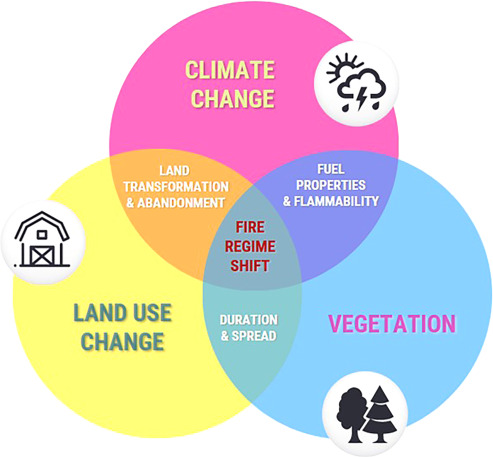
Fire plays a crucial role in healthy ecosystem functioning and the carbon cycle. As climate change accelerates, understanding the impact of a warmer world on fire-adapted ecosystems becomes an urgent priority. Fire regimes are rapidly shifting to new states due to altered fire weather and increased fuel flammability, the results of which are increasingly being seen in more frequent and intense fires in many regions of the world. Changing human population dynamics and land management practices compound the problem by modifying ignition patterns, fuel availability, and nutrient cycles. However, unprecedented changes on short timescales, limited observations, and the complexity of coupled ecological-fire processes present significant barriers to accurately projecting the future health of fire-adapted ecosystems around the world. This commentary emphasizes the need to better understand the impact of human activity on fire-adapted ecosystems, the implications of changes to fire-adapted ecosystems for climate mitigation and society, and an urgent need to advance the discussion on how best to sustainably manage and adapt to fast evolving fire landscapes.
Authors & Contributors

Related posts:
 Wildfires and global change
 Decolonizing wildfire risk management: indigenous responses to fire criminalization policies and increasingly flammable forest landscapes in Lomerío, Bolivia
 Conceptualizing a probabilistic risk and loss assessment framework for wildfires
 Rethinking the agricultural use of fire and its influence on the occurrence of wildfire in high Andean communities of Cusco, Peru