
Our Work

Solutions
Our Work
Across the globe, billions of dollars of capital is invested each year in efforts to research, prevent, fight, and recover from wildfires. However, this investment is not uniform across all regions and nations impacted by fire, leaving many communities without sufficient scientific knowledge to develop effective strategies for their specific constellation of variables. The Global Wildfire Collective carries out an array of activities to aid in the development and dissemination of knowledge and strategies.
Global Wildfire Collective Academy
As wildfire impacts grow in scale and complexity, the science used to understand and anticipate them must be matched to different questions, timescales, and decisions. The Global Wildfire Collective (GWC) Academy is designed to amplify and apply this science to increase the resilience of institutions and communities through training modules, workshops and webinars.
Fire Modeling Literacy Program
Fire Science Webinar Series
GWC Discussion Forum



GWC Spatial Data Gateway
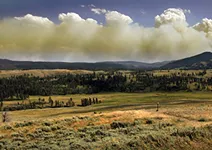
The Global Wildfire Collective Gateway is a platform for discovering and sharing wildfire-related research publications, spatial datasets, models, and more!
Events
The Global Wildfire Collective promotes discussion and action through fire science webinars, regional dialogues and capacity-building training, and engagement in UN processes and other global fora.
Past Events
The Future of GWC
Global Wildfire Collective - Latin America and the Caribbean
The Latin America and the Caribbean (LAC) region requires additional financial and technical capacity to enable local communities, fire departments, and government agencies to establish adequate wildfire prevention and resilience responses. In partnership with the Academia Nationale de Bomberos de Colombia, the Global Wildfire Collective-LAC (GWC-LAC), is building out capacity to provide wildfire science and management strategies to increase LAC regional resources and expertise. GWC-LAC combines cutting-edge wildfire and conservation research and education with state-of-the-art management and operations. It will also empower national policymakers and local communities to increase their climatic and ecological resilience to wildfire and facilitate wildfire recovery.