



Mediterranean-type ecosystems, like those in Southern California’s native shrublands, are being invaded and sometimes replaced by non-native herbaceous plant species, potentially increasing wildfire ignition risk and spread in a positive feedback loop called the grass–fire cycle.
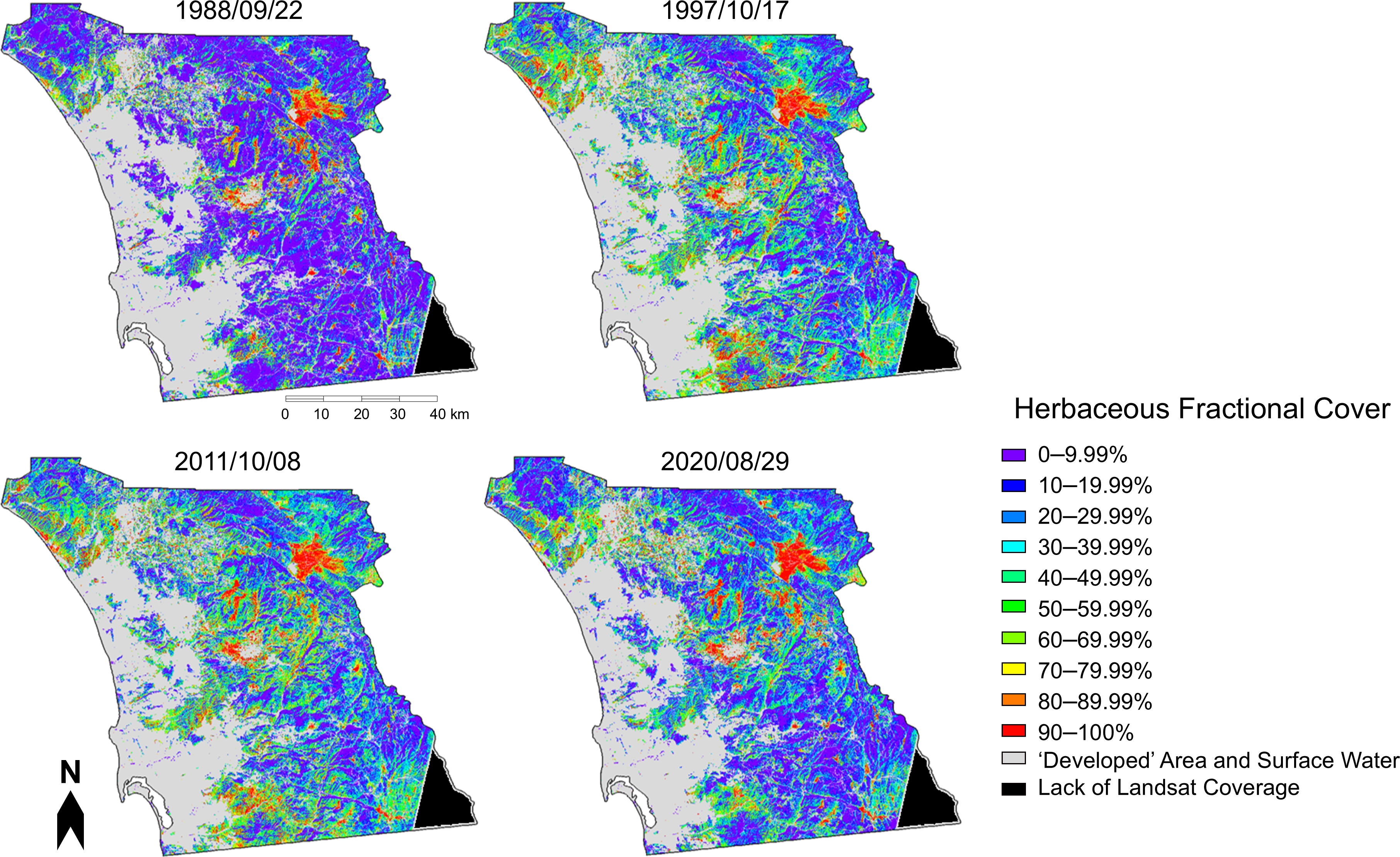
To assess whether a grass–fire cycle is occurring in Southern California, the researchers evaluated the association between historical wildfire ignitions and Landsat-derived, spectrally unmixed herbaceous fractional cover (HFC) maps.
Study results supported that a grass–fire cycle indeed exists in Southern California. Areas with greater than 40% herbaceous fractional cover were shown to experience increased fire occurrences.
This >40% threshold serves as a quantitative metric for prioritising mechanical thinning or prescribed burns, particularly near high-use roads and human development, as exceeding this level significantly increases landscape vulnerability to human-caused fires.
Authors & Contributors
Related posts:
 Surviving in a hostile landscape: Nothofagus alessandrii remnant forests threatened by mega-fires and exotic pine invasion in the coastal range of central Chile
 Exploration of large-scale vegetation transition in wet ecosystems: a comparison of conifer seedling abundance across burned vs. unburned forest-peatland ecotones in Western Patagonia
 In the right place at the right time: Microsite and sowing season drive post-fire restoration of an endangered conifer
 Where to escape the fire? The University of Chile proposes a framework for evacuation in the event of urban-rural interface fires