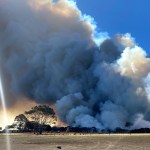




After a weekend of extreme heat and windy conditions, more than 30 blazes were still burning in Victoria and New South Wales as of Sunday evening, including major fires in the Otways, near the town of Alexandra in central Victoria, and on the NSW-Victoria border near Corryong.
And in northern Australia, Cyclone Koji brought heavy rain and fierce wind gusts as it crossed the coast Sunday into north Queensland.
What role does climate change play in supercharging extreme weather conditions, such as these? The evidence shows it not only turns up the thermostat, it also makes the climate system more erratic.
One emerging aspect of such climate change is “hydroclimatic whiplash” – sudden and often frequent transitions between very dry and very wet conditions. It can feel like the climate system is toggling between lots of different states: floods one minute, bushfires the next.
Australians are familiar with the El Niño Southern Oscillation (ENSO), the climate phenomenon in the Pacific Ocean with El Niño (warm) and La Niña (cool) phases that significantly impact global weather. But climate change means our weather is now operating in new and novel ways.
Authors & Contributors

Related posts:
 Why clearing the brush around Los Angeles won’t reduce the wildfire danger
 As Earth Warms, California Fire Season Is Starting Earlier, Study Finds
 Broad coalition urges California Governor, legislative leaders and local elected officials to rebuild Los Angeles to country’s strongest building code
 A New Paradigm for Protecting Homes from Disastrous Fires